In Short:
- Rated capacity is set at a fixed load centre, 600mm under the Australian standard AS 2359.1, not at the tip of the forks.
- Mast height, attachments and off-centre loads all reduce how much a forklift can safely lift below its nameplate figure.
- Size to your heaviest and most awkward load, not your average pallet, so you never come up short on site.
- Waverley Forklifts hires equipment from 1.5 tonne warehouse units to 16 tonne machines, plus telehandlers, across six states.
- Hiring lets you match capacity to the job in front of you instead of guessing or over-committing to a machine you don’t need.
A forklift’s tonnage rating looks like a fixed number, but it rarely is. A machine rated at 2.5 tonnes on the showroom floor might only manage 1.8 tonnes once you fit a fork extension or raise the mast to the top of your racking. Get the sizing wrong and you either pay for capacity you never use, or worse, ask a machine to lift more than it can safely handle.
This guide breaks down how forklift capacity actually works, walks through how to calculate the size you need, and points you toward the right forklift hire once you’re ready to book.
How forklift capacity ratings actually work
Every forklift is fitted with a load capacity data plate, sometimes called a rating plate or nameplate. It states the maximum weight the machine can lift, but that figure only applies under the exact conditions listed on the plate: a specific lift height, a specific load centre, and the machine in its standard configuration.
In Australia, the load centre used for that rating is set at 600mm from the fork face, based on the dimensions of a standard local pallet. This comes from Australian Standard AS 2359.1, which governs the design and rating of powered industrial trucks.
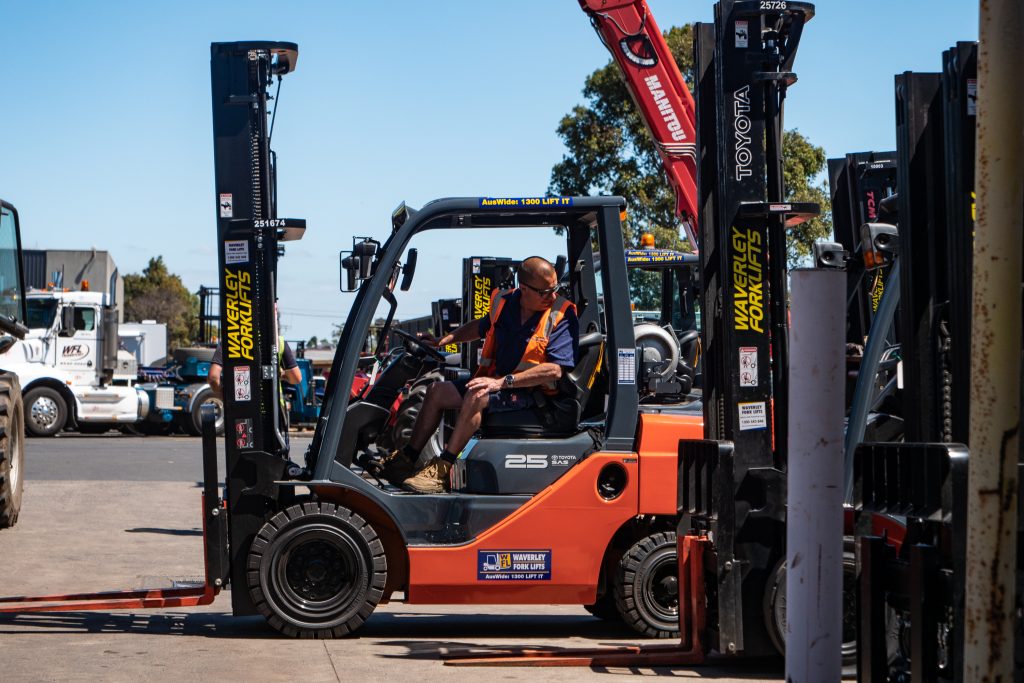
- The data plate is the only reliable source for what your machine can lift. Stencilled model numbers on the chassis, like “25” or “35”, are not a tonnage figure.
- Attachments need their own rating. A fork extension, clamp or rotator adds weight and shifts the load centre, so it carries a separate, lower de-rated capacity.
Checking the plate before every shift is part of the standard pre-start routine set out in Safe Work Australia’s general guide for industrial lift trucks.
What size forklift do I need? Working out your load
Hiring removes ownership risk while keeping operations moving.
- Weigh your heaviest single load. Size to the worst case you’ll actually lift, not the average pallet that moves through your site most days.
- Measure the load centre. This is the distance from the fork face to the centre of gravity of the load. A compact pallet sits close to the standard 600mm mark. A long item, such as a 2,400mm length of timber, pushes the load centre out to around 1,200mm.
- Note your maximum lift height. The height of your top racking level or truck deck, not just the average shelf.
- List any attachments. Fork extensions, clamps or a fork positioner all reduce the machine’s usable capacity for that job.
- Build in a margin. Aim to keep every lift within roughly 85 to 90 percent of the rated capacity for that exact configuration, rather than lifting right to the limit.
Why load centre, height and attachments change your numbers
A forklift’s rated capacity moves with three factors, and each one works against you if it’s ignored.
- Load centre. As a rough guide, doubling the load centre roughly halves the safe lifting capacity. A 2.5 tonne forklift rated at 600mm might only manage 1.2 to 1.3 tonnes once the load centre stretches out to 1,200mm.
- Lift height. Capacity is highest at the base of the mast and drops as the forks rise, because a raised load has a greater effect on the machine’s stability. The same 2.5 tonne machine may be rated closer to 2.0 tonnes at full mast height.
- Attachments. A clamp or rotator adds dead weight in front of the mast before you’ve even picked anything up, which comes straight off your usable capacity.
This is why two forklifts with the same tonnage badge can perform very differently on the same job. The number on the side of the machine is a starting point, not the answer.
Common forklift capacity ranges and what they suit
As a starting point, here’s how capacity typically maps to application across Waverley Forklifts’ hire fleet.
| Capacity range |
Typical machine |
Best suited to |
| 1.5 to 2.0 tonne |
Electric pallet truck, compact counterbalance |
Ground-level pallet moves, small warehouse racking |
| 2.0 to 3.5 tonne |
Standard counterbalance, reach truck |
General warehouse work, container unloading, retail distribution |
| 3.5 to 5.0 tonne |
Heavy-duty counterbalance |
Timber, steel, bagged product and drum handling |
| 5.0 to 16.0 tonne |
Heavy counterbalance |
Bulk freight, structural steel, port and yard work |
| Up to 4.0 tonne (extended reach) |
Telehandler |
Construction sites, events and agriculture on uneven ground |
If you’re also weighing up which type of forklift suits your environment, our beginner’s guide covers counterbalance, reach truck, order picker and rough terrain options in more depth.
Hiring the right size forklift near you
Hiring gives you a way around the guesswork. Instead of buying a machine sized for your busiest week, you can book the exact capacity a job needs and adjust as the work changes.
- Short-term hire suits one-off jobs, seasonal peaks or a single delivery where you need a specific capacity for a few days or weeks.
- Long-term rental suits ongoing operations, with fixed monthly costs and servicing included so capacity planning doesn’t fall on your team.
- Our hire team can confirm the right capacity, attachments and configuration for your load before the machine leaves the yard.
Waverley Forklifts operates branches across Victoria, New South Wales, Queensland, South Australia, Western Australia and the Northern Territory, with a full forklift hire range from 1.5 to 16 tonnes, plus all-terrain forklifts and telehandlers.
Key Takeaways:
- A forklift’s rated capacity applies only at a specific load centre, height and configuration, not as a flat number.
- Always work from the load capacity data plate on the machine, never from a model number stencilled on the chassis.
- Size to your heaviest, longest or most awkward load, and build in a margin rather than lifting to the limit.
- Attachments and raised mast height both reduce usable capacity below the nameplate figure.
- Hiring lets you match capacity precisely to the job, and adjust it again once the job changes.
Still not sure what capacity your job needs? Get in touch with our hire and rental team on 1300 LIFT IT and we’ll match you with the right machine, attachments and configuration for the load in front of you.